

We Were in 'Hamlet' Before We Knew It
An evening watching the premiere of Riz Ahmed's 'Hamlet', and a commentary on reclaiming narratives


I learned Wednesday night, Shakespeare made up, invented, put into the universe, four thousand words. When you think about it, that’s insane. An individual revered for being an authoritative voice of English literature & drama, many a time was not even using English.
As I sat, fully engrossed in ‘Hamlet’, I was aware that much of the dialogue was going over my head. However, there was a feeling, one I couldn’t quite explain. One where I could feel what the characters on screen were feeling. One that gave me an understanding not just of what was going on, but that I was dropped in the moment they were in, living it with them.
This feeling is not uncommon for those of us from multiple cultures and languages. Growing up visiting Pakistan during my formative younger years, I was used to Urdu being spoken around me; and in somewhat of a symbiotic nature, used to relying on my surroundings as a way to comprehend. It was less about understanding 100% of the language, and more about absorbing mannerisms, facial expressions, and tone to piece together the puzzle of a foreign, yet remarkably familiar environment. As I taught myself Urdu as an adult, I noticed how being immersed in the world, in the land, and speaking it there, took me miles further than learning a language within a silo far away. In a way, I was thinking about Shakespeare’s English like this. Reading the words on a page in high school English class is markedly different from watching it unfold on screen, seeing Riz Ahmed’s pain at his father’s funeral, or battling his inner demons throughout the film.
To paint a picture, the film is a modern-day adaptation, set within the context of a wealthy British Indian family, however almost all of the dialogue was that of the original play. This juxtaposition was disarming, and going into the film without knowing this, I noted was uncomfortable for a lot of people, especially those of an older generation. With this, came the names of the characters being left untouched from the original screenplay; meaning that Riz Ahmed, Sheeba Chaddha, and Art Malik were Hamlet, Gertrude, and Claudius accordingly.
From my perspective, Ahmed’s Hamlet was not a “south asian” rendition, but rather, a terrific example of mythopoeia. Mythopoeia being the idea that no story is truly original— that the great narratives of human experience have always been borrowed, reimagined, and continue to be built upon through history and into the future. Shakespeare embodied this notion, with only two pieces within his extensive body of work being original plots: The Tempest & Love’s Labour’s Lost. The rest were in fact adaptations of existing stories, reimagined within his purview, with a cultural context fitting for the time. In the case of the story of Hamlet, there is a prevailing debate over the philosophical parallels between it and the Bhagavad Gita. The debate centers on Hamlet and Arjun’s shared moral crisis— of action, or often inaction, and the weight of its moralistic implications. One of the most palpable feelings throughout this rendition is just that— Ahmed’s portrayal of Hamlet’s inner battle. A battle of not just whether to live or die, but more profoundly, to exist passively, inactive, frozen, or to rise against the injustices of the world we live in.
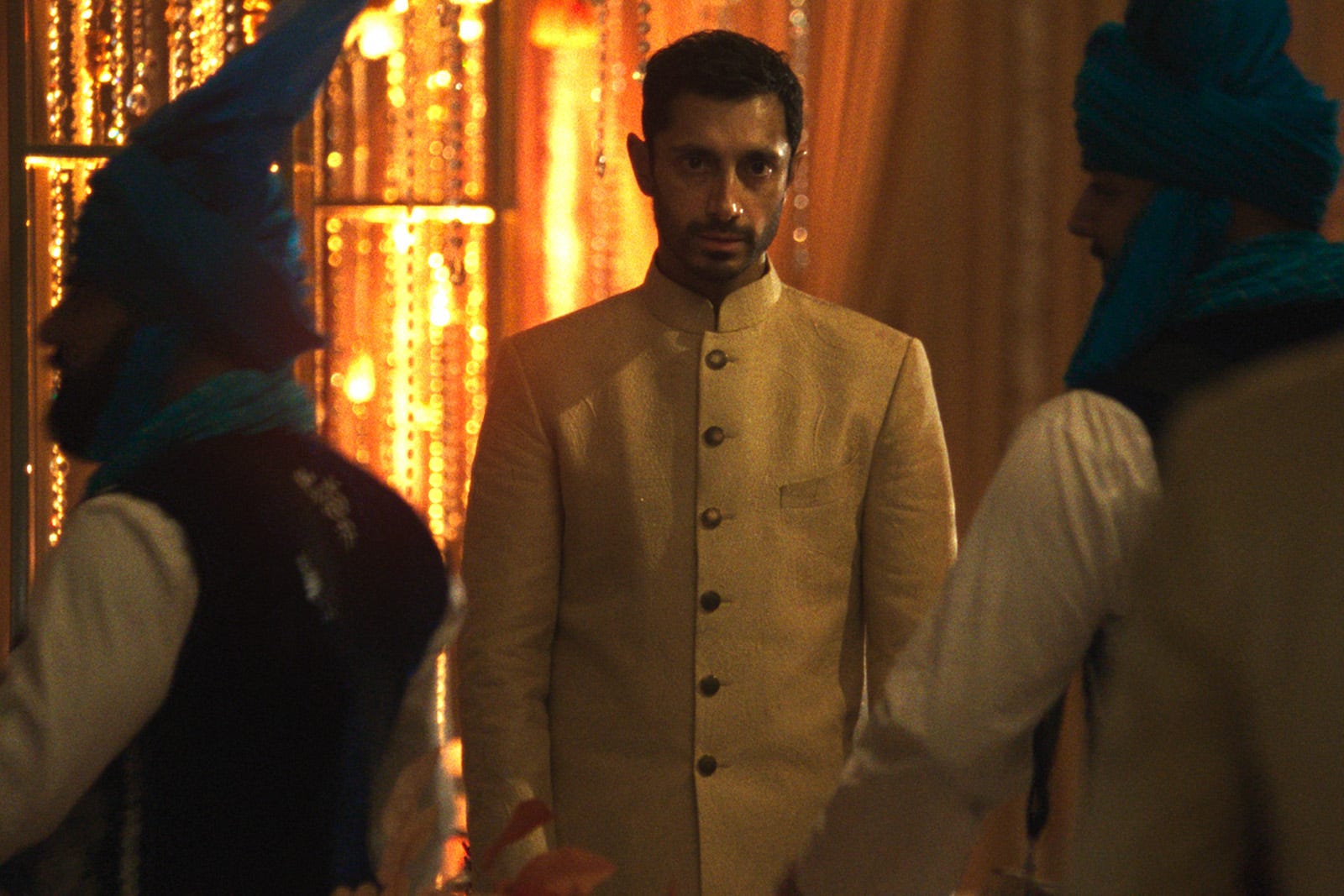
This comes to a head with the most famous line, arguably in all of Shakespeare’s body of work, ‘to be or not to be’. A line that has come to represent the existential crisis, of life or death. However, during the post film Q&A, one moment that most resoundingly stuck with me, was Ahmed’s commentary on his interpretation of that line. That ‘to be or not to be’ is about something far more radical and confronting. Hamlet is not asking if he should kill himself, but rather, should we fight back against the injustices of the world, even if we stand to lose everything in that fight? This question itself is no longer hypothetical, but rather an everyday confronting reality I ask myself, everyday, in the state of the world we live in now.
It’s interesting how quite often the commentary on “modern interpretations” of classics, is one questioning the politicization of said interpretation. However, Ahmed argues, that isn’t contemporizing anything at all, a form of politicizing it? I paused on this for a few moments. The idea that when a story, an epic, a myth, exists in the past, through the veil of history, we can remove ourselves from it. However when we bring it to the current day, and place it in a contemporary environment, we can’t escape the parallels it draws to our lives and politics. And in that vein, aren’t we as South Asians, Pakistanis, Indians, a part of the contemporary narrative across the globe? Within America, England, and the rest of the globe, we contribute to the fabric that weaves together the identity of a place. We don’t exist in silos. As Ahmed points out, the story of Hamlet is in many ways overtly South Asian— Hamlet being disallowed to marry the woman he loves because of the family she comes from, a fight over a family business and inheritance, shifting dynamics of marriage & family, and even grand ‘performances’ at weddings. All permeating themes we see within our subculture, yet often difficult to see during an 11th grade assigned reading of ‘Hamlet’ (which did in fact end up being mainly Spark Notes).
As is with the genius that is Riz Ahmed, you will probably be tempted to watch this just for him. I encourage you to do so for that, and for what it stands for in the culture we are building. For the notion that we are building not representation, but rather fabrication, weaving ourselves and our culture into the fabric of the places we live. For third culture to exist as a culture, not a subculture.
Let us know what you thought about the film when you watch it, and thank you to Asia Society for hosting the premiere. And to Riz, thank you for reminding us that we were always a part of the story.
 | A guest post by
|